BMS Beginner Cohort — Build Lasting Balance
Build Lasting Balance for the Life You're Not Done Living.
A 6-session system that helps you build the balance and confidence to handle long travel days, stairs, cobblestones, trails, and the active life you still want.
The last third of your life should be the best third.
That only happens if your body keeps up.
Sound familiar?
Your world is getting a little more careful. You probably haven't named it that way yet.
It doesn't happen all at once. You don't decide to stop hiking, traveling, or taking the stairs. You just start choosing the easier option. The smoother path. The shorter walk. The elevator. The safer trail.
At first, it feels practical. Then it becomes the new normal. Life doesn't shrink dramatically. It shrinks quietly. And most of that shrinking is not inevitable.
You hesitate on the cobblestone side street in Lisbon. You hold the railing. You pick the flat path instead of the trail you used to love. You're rethinking that trip.
What you fear most isn't a fall. It's the slow narrowing, losing access to the life you still want. Travel. Hiking. Long days on your feet. New cities. The trail with your partner you've been planning.
That loss of access is the real cost. Not the fall. The life you begin to work around.
Why balance really fails
Most people have never been taught how to train it.
Most people assume balance gets worse because they are getting older. That is not the whole story. Balance is trainable. The problem is that most people have never been taught how to train it properly.
They are given random exercises. Stand on one foot. Walk in a line. Try a wobble board. Close your eyes. But those exercises don't answer the questions that matter: Where should I start? How hard should this be? How much support should I use? Am I improving? What do I do next?
Without a system, balance training becomes guesswork. And when people practice while wobbling, bracing, or grabbing for control, they are often practicing the very uncertainty they are trying to change.
Your nervous system has one job: keep you safe. Every injury, every surgery, every repetitive stress, even from decades ago, teaches it to protect. It tightens. It limits output. It makes your body overcorrect. And that protection doesn't turn off on its own.
BMS works differently.
You learn how to assess your balance, find the right level of challenge, use the right amount of support, and train at the edge of your ability while staying steady and in control
Balance is not something you either have or have lost. It is something you can train.
When you know where to start, how much support to use, and how to progress, balance stops feeling mysterious. You begin to trust the process. Then you begin to trust your body.
And when that trust comes back, more of life starts to feel available again. Not a protected version of yourself — your full capacity.
Three weeks from now, you should feel different on your feet. Steadier. More capable. More confident in how your body responds. You will not be finished, because balance is something you keep training. But you will know what you are doing.
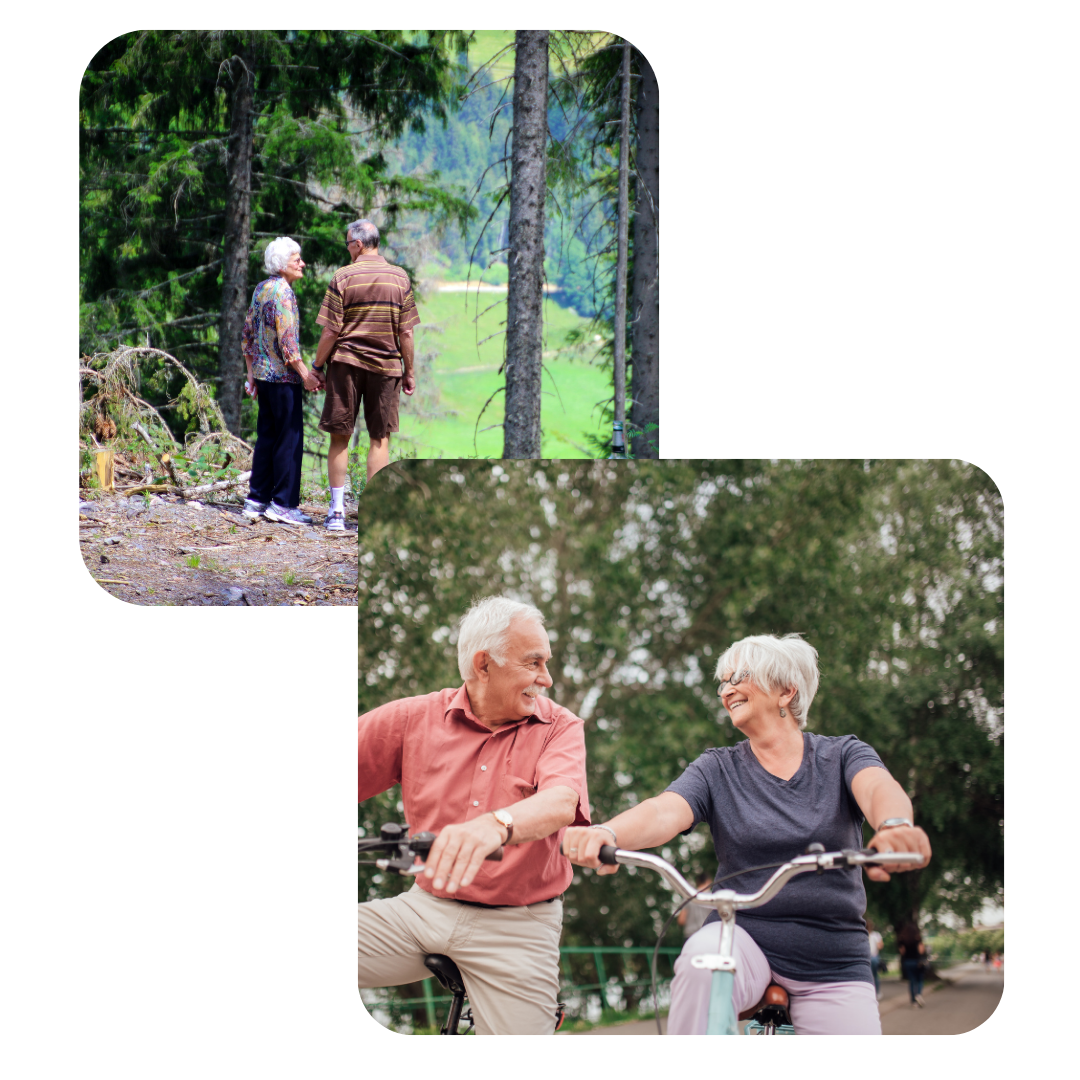
Introducing...
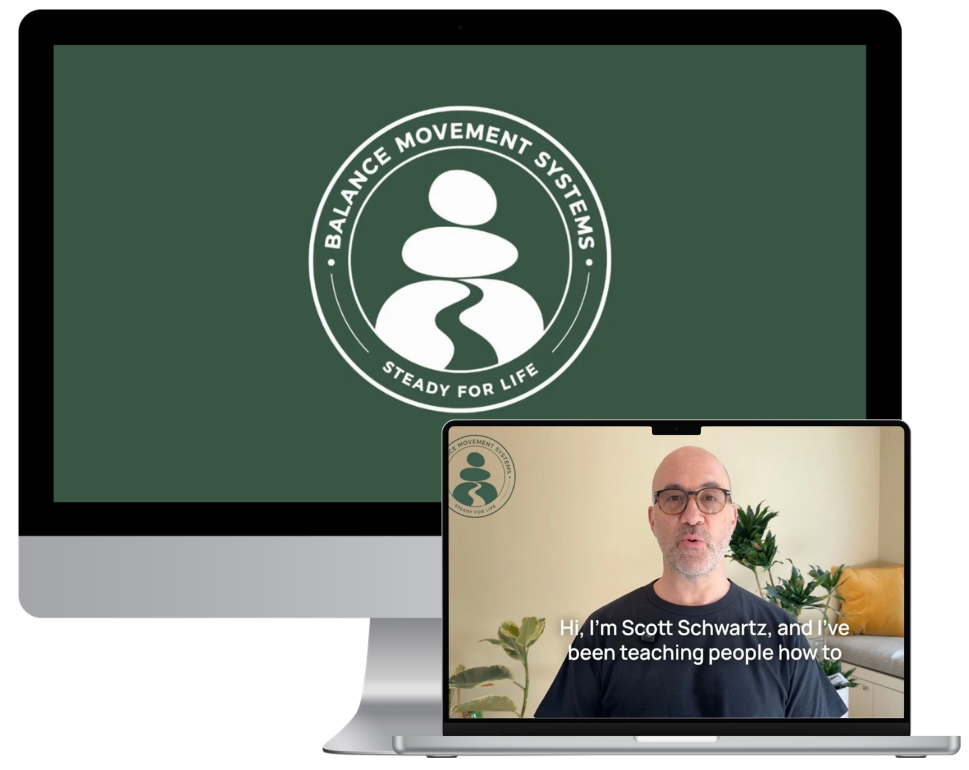
BALANCE MOVEMENT SYSTEMS
A method — not just exercises.
Most balance programs give you exercises. BMS gives you a system. An exercise tells you what to do. A system tells you where to start, how hard to work, how much support to use, how to progress, and how to know when you are improving.
You are working close to your edge, but not past it. Supported. Steady. In control. That is where the training happens.
Get Started with Balance Movement SystemsA Clear Progression
BMS uses a 6-rung progression ladder that moves from more stable to more challenging. You start where your body can work cleanly, then progress one step at a time. No guessing what comes next.
A Repeatable Assessment
Every session begins by finding your Unassisted Balance Point — where your balance holds without support. That gives you a clear starting point. When it moves, you can see your progress. It's measurable and real.
Precision Support
Hand support is a skill, not a crutch. It's the tool that keeps you challenged but clean — working right at your edge without triggering the protection that makes wobble worse.
The Cohort Journey
What happens across six sessions.
Each session builds on the last. By the end, you don't just have better balance — you have a system you own and can use independently for life.
Foundations — Before You Begin
15 short concept videos teach you the BMS vocabulary before Session 1. You'll learn what wobble means, what clean balance looks like, and how your nervous system affects your balance. Strength activation videos for glutes, quads, and calves so you arrive with more capacity and more confidence.
Session 1 — The System
You learn how the BMS system works in practice. We walk through all three movement progressions — side to side, diagonal, and forward and back — and you feel the difference between wobble and steadiness in your own body for the first time. Homework: 10 minutes a day.
Session 2 — Your Assessment Tool
This is where everything clicks. You find your Unassisted Balance Point — the exact edge where your balance holds without support. You learn to work just past it, using hand support to stay clean. You now have a self-assessment tool you'll use for life.
Sessions 3 & 4 — All Three Progressions
We add the diagonal and forward/back progressions — two new directions that challenge your balance in new ways and mimic real-world instability. By the end of Session 4, you're working all three progressions confidently. Your UBP is moving. You can feel it.
Sessions 5 & 6 — Recovery & Full System
You learn that you've been training recovery since day one. We bring that into focus, refine your precision with foot position and hand support, and consolidate everything into a complete independent practice. You graduate with a system you own — not just exercises you've been shown.
Everything Included
Everything in the cohort.
One enrollment. Everything you need to learn the system and build a practice that lasts.
- 15 pre-cohort foundation videos — all BMS concepts explained before you begin
- 3 strength activation follow-alongs — glutes, quads, and calves, one week before cohort starts
- 6 live teaching sessions with Scott — delivered as cohort videos with full instruction and demonstration
- Session homework guides — clear daily practice instructions after each session
- BMS Vocabulary Reference — the complete language of the system in one printable sheet
- Progress Tracking Sheet — log your UBP across all three progressions every session
- Private cohort community — practice check-ins, questions, and connection with other participants
- Lifetime access to all session recordings and materials
This is for you if…
- You're between 55 and 75 and you've noticed your balance isn't what it used to be
- You travel, hike, or stay active — and want to keep doing those things for decades
- You've tried balance classes, PT, or yoga and didn't see lasting results
- You feel hesitation in situations that used to feel automatic — stairs, uneven ground, crowds
- You want a system you can understand and use on your own, not just exercises to follow
- You're not ready to slow down, but you're aware that your body needs some attention
This is NOT for you if…
- You want a passive program you can do once and be done with
- You're not willing to practice between sessions or stay consistent over time
- You're looking for simple exercises rather than a system
- You're not willing to follow the safety rules — using support, staying in control, not practicing in the wobble
- You have an active injury or medical condition that requires clearance before exercise
Hey, it's Scott!
In 2015, I woke up and my balance was gone, overnight. I was told it would remain significantly impaired. I didn't accept that.
I spent years studying exactly how balance works, why it changes, and how to train it safely and precisely. What I built became Balance Movement Systems.
The people I work with aren't falling. They're hesitating on stairs, on trails, in crowds and they can feel the world getting quietly smaller. They want a system, not a set of random exercises. That's what this cohort gives you.
I keep it small because I want to work with you directly. Twenty people. If you don't understand the system by the end, I'll work with you one-on-one until you do.
— Scott Schwartz
Creator, Balance Movement Systems

The Balance Movement Systems Beginner Cohort starts July 7.
00
DAYS
00
HOURS
00
MINS
00
SECS
20 spots. One-time introductory price of $200. When the cohort fills or the clock hits zero — enrollment closes.
YES! SIGN ME UP
Join Our Free Trial
Get started today before this once in a lifetime opportunity expires.